Type: Journal Paper
Title: Rectifying Strip Patterns
Year: 2023
Authors: Bolun Wang, Hui Wang, Eike Schling, Helmut Pottmann
Published in: ACM Trans. Graph., Vol. 1, No. 1, Article 256.
Available: January 2023
DOI: https://doi.org/10.1145/3618378
Office: KAUST, Saudi Arabia; University of Hong Kong
Abstract
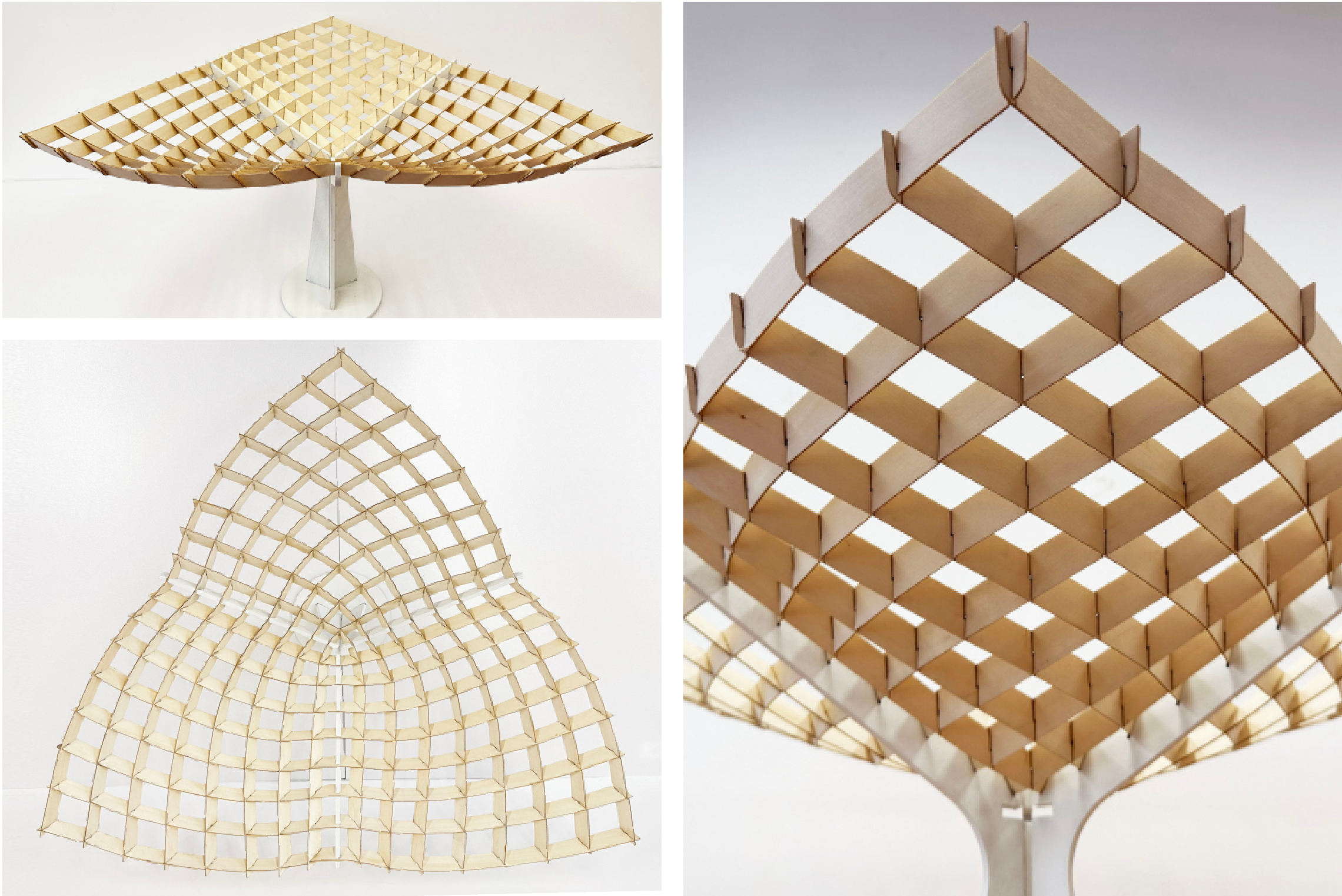
Straight flat strips of inextensible material can be bent into curved strips aligned with arbitrary space curves. The large shape variety of these so-called rectifying strips makes them candidates for shape modelling, especially in applications such as architecture where simple elements are preferred for
the fabrication of complex shapes. In this paper, we provide computational tools for the design of shapes from rectifying strips. They can form various patterns and fulfil constraints which are required for specific applications such as gridshells or shading systems. The methodology is based on discrete models of rectifying strips, a discrete level-set formulation and optimisation-based constrained mesh design and editing. We also analyse the geometry at nodes and present remarkable quadrilateral arrangements of rectifying strips with torsion-free nodes.
Keywords:
architectural geometry, computational design, computational fabrication, gridshell, shading system,
pseudo-geodesic

 Geometry.Design.Structure